
What is Connections Reform?
Connections Reform is a major overhaul of the electricity transmission connections process led by the National Energy System Operator (NESO).
This new initiative aims to speed up connections for vital net zero projects and removes unviable developments from the connections queue. On the 15 April 2025, Ofgem approved the proposed Connections Reforms by NESO which will transform the connections process to better facilitate clean power for 2030 and beyond.
The main objective of Connections Reform is to create a connections queue, aligned with the CP30 Action Plan, with three key features:
- Viability – by prioritising ‘ready’ projects, the Gate 2 queue is made up of projects that are demonstrably viable and progressed (having land rights or sufficiently progressed their planning status).
- Need – by aligning with the CP2030 Action Plan, and any future strategic alignment criteria set by the Government, the Gate 2 queue is made up of projects that best meet current and future system need.
- Efficiency – the mix of ready projects aligned with Strategic Alignment Criteria is preserved, with projects that drop out being replaced by projects with the same technology.
This will enable an increased rate of connections through efficient network build and increase customer confidence in connections to enable investment. Once implemented, this will result in a more efficient process and network design, benefitting both customers and consumers.
Why is Reform Needed?
In 2023/24, NESO received more than 1,700 applications, and more projects are already in the queue than is required for the energy system in 2030 or even 2050.
To illustrate this, the Department for Energy Security and Net Zero (DESNZ) has highlighted in our two licence areas, we need a combined 11.4GW to meet Clean Power by 2030, with our current connections queue over 5 times this size.
This backlog includes numerous projects that may never materialise, leading to extended connection timelines for viable developments. Connections Reform requires projects to meet ‘readiness’ and ‘alignment’ criteria to ensure only viable connections are progressing to be connected.
Connections Reform Update
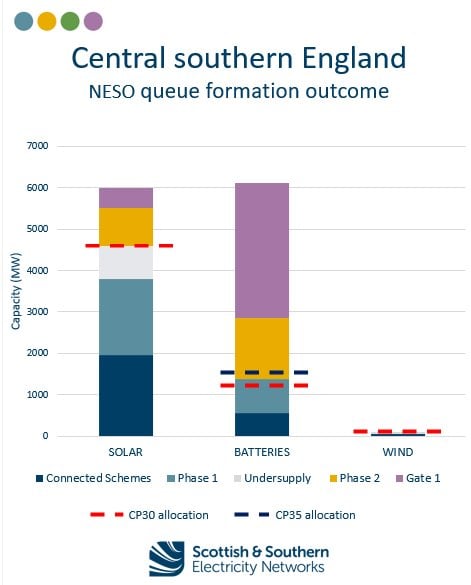
Following receipt of the reformed connection queue from the National Energy System Operator (NESO), we wanted to show what the new queue looks like in our north of Scotland and central southern England licence areas:
STORAGE
We’re oversubscribed against the 2030 and 2035 Clean Power capacity allocations in both licence areas, due to the number of protected schemes. All non-protected storage projects received a Gate 1 offer.
SOLAR
There is a small undersupply in the north of Scotland and a larger undersupply (around 800MW in central southern England) versus capacity allocations for the Clean Power 2030 target. While there were “ready” solar projects seeking to connect prior to 2030 in our central southern England licence area, unfortunately they weren’t successful in advancement requests made to NESO and TOs and so remained in Phase 2. The 2035 solar capacity is shared with Transmission, so it’s not shown on the graphs provided.
ONSHORE WIND
In the north of Scotland, there was an undersupply by 180MW for our 2030 allocation, but this was reallocated into Phase 2. Due to the difficulty in achieving planning permission in central southern England, no onshore wind projects applied in this process.
If you have any queries, please contact us at reformsupport@sse.com

Latest Developments
-
Connections Reform Timeline Update – 13 February 2026
On 13 February 2026, NESO published an updated timeline for the Connections Reform process. For our Distribution customers, those with 2026/2027 Protected dates are to receive their offers between early March 2026 to the end of May. For Gate 2 Phase 1 projects, offers are to be issued between early July and mid November. Gate 2 Phase 2 customers are to hear between mid October 2026 and mid March 2027, with Gate 1 timelines still to be confirmed.
-
Government's Clean Power 2030 (CP30) Action Plan
The UK government have set out an action plan for reaching their target of clean power by 2030 to increase energy security and improve affordability, while reducing greenhouse gas emissions. To meet these targets, NESO have published capacity ranges for solar, onshore wind and batteries to 2030 and 2035 across DNO licence areas to help achieve clean power.
-
Implementing Connections Reform (CMP434)
CUSC Modification Proposal 434 (CMP434) introduces a gated application process for new applications with two formal stages – Gate 1 (indicative offer) and Gate 2 (confirmed offer). To progress to Gate 2 and receive a connection offer, customers must meet 'Readiness' and 'Alignment'criteria. NESO are still to confirm the timeline for when this next application window will open and the scope of this.
Relevant Links
SSEN Submission Portal
To support customers through the Gate 2 process, SSEN launched a dedicated evidence portal, enabling users to securely submit their Gate 2 documentation. The portal was open from 19 May to 26 August for customers with existing connection agreements. During this period, we received a total of 288 submissions across our two licence areas.
Looking ahead, customers seeking new connection applications will also need to meet the Gate 2 readiness criteria. NESO are still to confirm the timeline for when this next application window will open and the scope of this.
If any new customers or customers with a Gate 1 offer wish to apply for a Gate 2 offer, please email us at reformsupport@sse.com to inform us and we can set you up on our Gate 2 submission portal.
The evidence customers will need to submit is briefly summarised here, Connections Reform – What’s next for SSEN Distribution customers – SSEN, with the detail found within NESO’s Gate 2 Criteria Methodology.
Webinar and Contact
SSEN regularly holds informative webinars for our customers and stakeholders, including a mini-series on Connections Reform topics. Keep up to date with the latest and upcoming webinars here - Home | SSEN