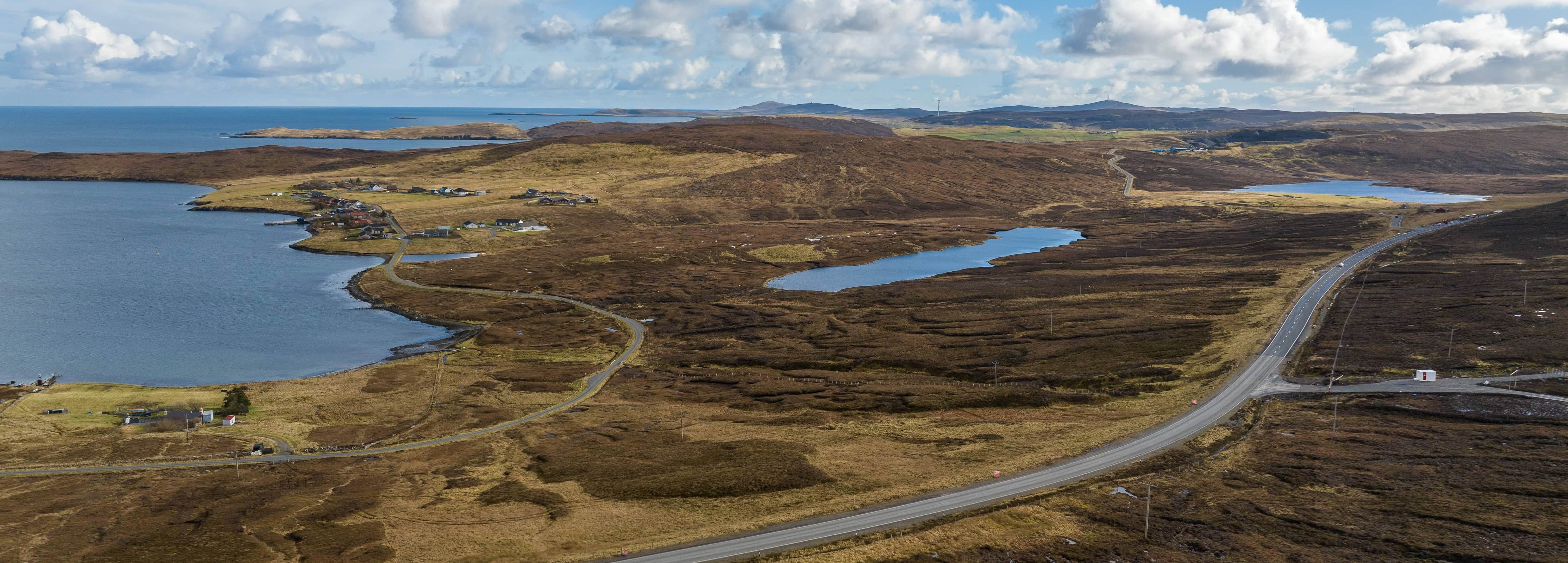
We've revised our plans for the next phase of Shetland’s North Mainland network reinforcement project. These changes – designed with the agreement of Shetland Islands Council – will mean the works can be completed more quickly and reduce the project’s effect on the local environment. Community information sessions to inform the public of these revised details will be held early next year.
As part of a commitment to minimising the impact of our work on the communities we serve, we've been consulting with Shetland Islands Council (SIC) on changes to the original project plans.
These proposals - which have now been confirmed - will shorten the envisaged project timeline by several months as well as delivering wider environmental benefits.
Our project, which got under way earlier this year and is due to be completed by the end of 2026, will increase network capacity, thus supporting the installation of low carbon technologies such as heat pumps and EV chargers in customers’ homes. It will also enable the decarbonisation ambitions of major industries, while the increase in available network capacity will aid future economic growth in Shetland. The upgrade will also further improve the reliability of customers’ supplies across the North Mainland.
A major part of the project is the installation of two new 43km underground cables between Sullom Voe and Gremista. The original plans were for these cables to be installed along a route taking in both the public highways and off-road locations. Now, following discussions with SIC, the cables will be installed solely along the public highways.
Steven Cowie, SSEN Distribution’s Project Manager, explained more about the background to these updated plans:
“We want to deliver this project in the safest and most environmentally-friendly way possible, while also minimising our work’s impact on the local community. As part of this commitment, we carry out regular evaluations of our designs, plans and timetables – including projects which are still on the drawing board as well as those already in construction.
“As planning progressed, our contract partner - OCU Group - commissioned further in-depth studies. These assessed the off-road areas where we’d need to construct access roads as part of the cable installation. Water course crossings, soil type, slopes, crossfalls, surface water, peat, general access and the location of other utilities were all considered in great detail.
"As a result of these findings, we’ve revisited our original plans and agreed an alternative with SIC which avoids the construction of approximately 20km of access roads.”
By installing the cables solely on public roads, we believe the new plans will result in long-term environmental benefits for Shetland, while at the same time still enabling the delivery of this essential upgrade.
The benefits of installing the cables solely on the public highways include:
- Removing the need for major off-road excavations means a lower volume of construction transport and machinery. This will result in lower emissions over the duration of the project. Lower levels of construction traffic will also benefit local motorists’ journeys.
- Avoiding disturbance or disruption to the habitats of birds and wildlife on Shetland’s sensitive peatlands.
- And as there will no longer be any temporary access roads, this eliminates the need to restore these areas to their original condition after the cables have been installed. This will further reduce the duration of works and the environmental impact.
In keeping with the works that have already been completed, the cable ducting will be installed in 500m sections, with rolling traffic management in place at each section for the safety of road-users and staff working on site.
Steven Cowie continued:
“We appreciate the impact that work on the public roads can have on everyone’s day-to-day travel, and I’d like to thank the local community for their patience as we go about this essential project. To protect the safety of motorists and our workers, speed restrictions will be in place where we’re working, so I’d advise that people factor in some extra time for their journeys.
“I’d also like to reassure everyone that we’ll continue to have regular discussions with SIC Roads to ensure that our work areas are reinstated to a high standard.”